How long do brakes last? When should you replace them?
One of the essential features in a car is the brakes to remain safe on the road. It is also about confidence: Feeling that your brakes are not up to the task of stopping your car is plain frightening. You do not need the stress.
Luckily, there are a few easy ways to know when you need to get your brakes checked or replaced.
Why do brake pads wear?
The friction caused by the braking pad and the brake rotor slows down your vehicle. When the brake pads constantly rub against your rotors over time, they slowly start to wear away.
There are more reasons for this to happen.
- 1-Driver error: Driver error is the most common cause of abnormally fast wear. One example is with “two-footed” drivers who use their right foot to work the accelerator and their left to work the brake.
- 2-Corroded Slide Pins: The caliper must be able to slide smoothly and evenly at all times.
- 3-Using Cheap Pads: You’ll find replacement pads available for a wide range of prices, and the natural inclination is often to go for the lower-priced option. However, cheap pads generally don’t last very long. In addition, they can contain chunks of metal that will eat into your rotors. Avoid low-quality pads even if it means paying a little more.
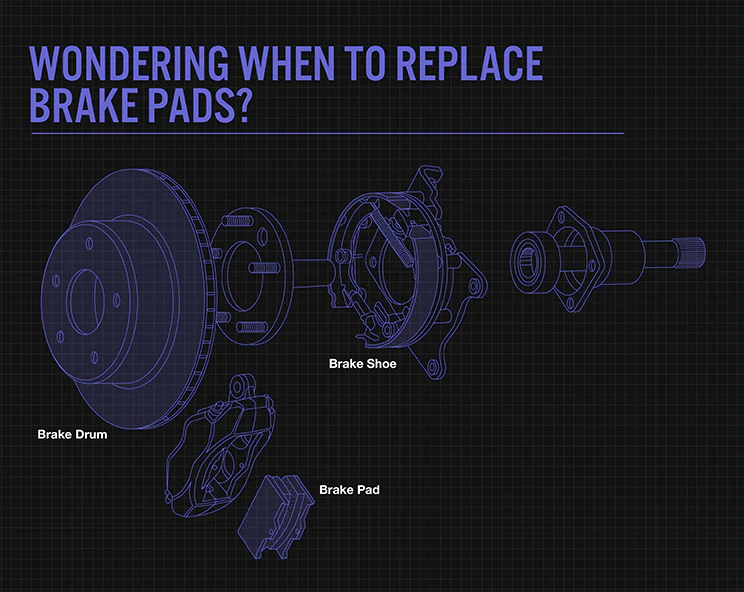
WHAT HAPPENS WHEN BRAKE PADS/SHOES WEAR OUT?
Every time you engage your vehicle’s brakes, a small amount of friction material wears off the pads or shoes. Over time, the friction material will become thinner. If the pads or shoes are not replaced, the friction material will wear off entirely, exposing the steel pieces that held the material. When these steel pieces come into contact with the discs or drums, excessively long braking distances and damage to the discs and drums will result.
Look for these signs to know when to replace brake pads or shoes:
1-Squeaking or screeching noises:
If a vehicle’s brake pads have to wear indicators, a driver may notice a squealing, screeching, or whining noise when the brakes are engaged. This sound is caused by a small metal attachment on the brake pad that backs the plate for just this purpose. Wear indicators work on the same principle as dragging fingernails across a chalkboard. When you hear it regularly while braking, it’s time to replace your brake pads.
2- Indicator lights:
Some vehicles have an indicator light on the dashboard for replacing the brake pads. Check your owner’s manual to see if your vehicle comes equipped with a low-pad warning system. Remember that if the light does come on, you’ll need to have your mechanic replace the warning sensors as well as the brake pads.
3- Deep metal growling:
A deep low noise that sounds like metal grinding or a rumbling growl might indicate that not only are your brake pads worn away. Also, your brake pads backing plates are making contact with the discs or drums.
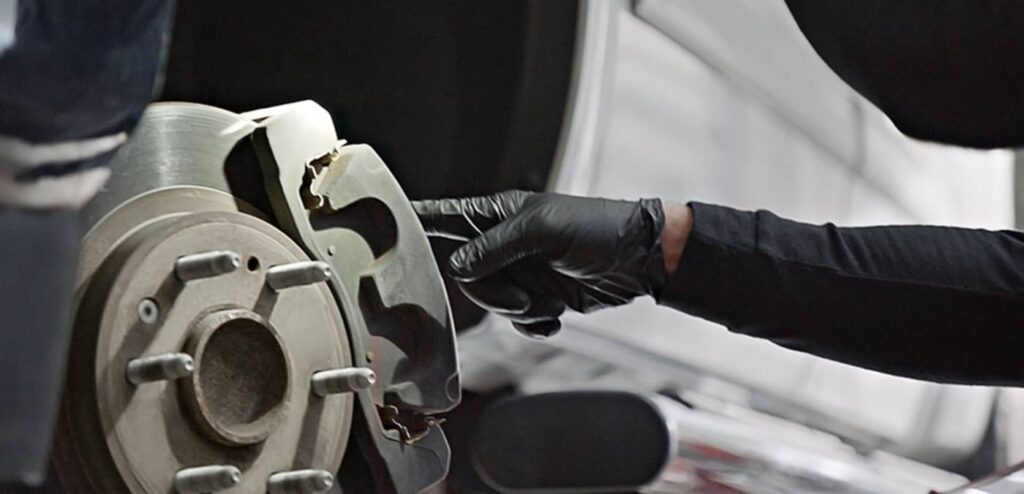
There are many ways to make brake pads last longer like:
- Follow speed limits, maintaining safe following distances.
- Regularly service your vehicle that worn car parts don’t damage other car parts.
- Remove any unnecessary weight from your car.
- Use engine braking.
- Keep your speed low in heavy traffic.
- Spray your brake rotors when you wash your car to get rid of dust (which adds friction to your brake pads).
- Use good-quality brake pads that are designed to last – search your number plate in our car lookup tool for options.
- Pay attention to traffic so that you can anticipate stops.
Brake pads usually last between three and seven years or 30,000 to 70,000 miles. However, front brake pads typically wear quicker than rear brake pads because the front part of your car takes more weight transfer when you brake.