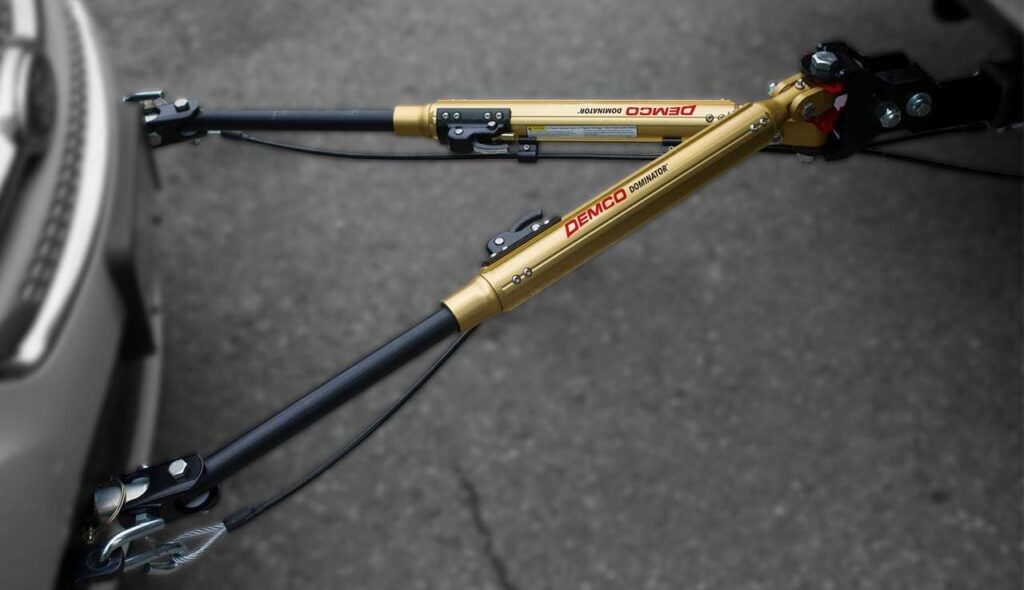
What is a tow bar?
A tow bar is a device that connects your vehicle to your RV for flat towing. Connect two vehicles using shafts, swivel arms and mounting brackets. A towed vehicle is called a dinghy, and when attached to an RV, it becomes a kind of trailer.
How does a Towbar work?
The tow connects the front of the dinghy vehicle and the rear of the RV. The camper tows the dinghy, and the hitch swivels for smooth towing. Dinghy vehicles must be equipped with a baseplate or bracket in the front. And motorhomes must be equipped with a motorhome towbar. The towbar runs between the dinghy and the RV, attaches to the RV’s towbar, and attaches to the vehicle bed.
Step-by-Step Tow Bar Setup
Step 1: Park on a level surface
First, park your RV on a flat, level surface with enough room to hoist the vehicle you’re about to tow behind it. Park the camper and apply the emergency brake.
Step 2: Make sure the hitch and base plate heights are within 3 inches
Make sure the height of the base plate mounting tabs is approximately the same as the height of the RV receiver hitch. The difference should not exceed 3 inches. Using a tape measure, measure from the ground to the center of the camper hitch mount (A). Then measure from the floor to the mounting tab on the front edge of the bid car (B).
A – B = C
If C is greater than 3, you need a hitch adapter.
Step 3: Mount the tow bar on the RV
Insert the towbar shank into the socket on the RV hitch. Then secure with pins and clips. Some towbars are designed with two or more pin holes in the shaft to allow extra clearance if needed. It is recommended to use the tow bar in the shortest possible position.
Also, if possible, fold the tiller arm up and out of the way to avoid vehicle interference in the next step.
Step 4: Park your vehicle behind the RV
Drive the vehicle slowly behind the camper, keeping the vehicle as parallel as possible. When the vehicle is almost in the tender tow position, stop, park, and apply the emergency brakes. Be careful not to drive into the tow bar. It would be nice to have a friend to help monitor the distance and let you know when to stop.
Step 5: Attach the tow bar arms
Insert the two mounting straps into the dinghy vehicle base plate mount. Then attach the hitch arm to the mounting tabs. Many towbars come with extendable arms that can be easily attached to tabs. Release the locking handle and extend your arm. Once in place, secure the arm and tab connections with linch pins.
Step 6: Prepare the dinghy vehicle for towing
After installing the tow bar, set the tender vehicle’s transmission for towing and unlock the steering wheel. Refer to your vehicle owner’s manual for proper flat towing procedures. Most vehicles would be put in neutral. You may also have special requirements. Follow all manufacturer guidelines.
Step 7: Engage the tow bar latches
Pull the camper forward very slowly to make sure the tow bar latch is fully engaged. Release the parking brake first. Then put the trailer in drive mode and take your foot off the brake. Stop when the tiller arm latches. Make sure both arms are latched before towing.
Step 8: Attach the safety cables
Attach the safety cables from the RV hitch safety loops to the base plate convenience links on the dinghy vehicle. While the cables should be crisscrossed once underneath the tow bar. But, the cables should not be dragging on the ground while towing.
Step 9: Plug in the wiring harness
Plug the dinghy vehicle into the RV electrical socket at the rear. Most RVs come with a standard 4-way flat socket. Connect the plugs and the emergency breakaway. The dinghy vehicle must be equipped with RV towing lights or a dinghy tow wiring harness to synchronize the RV taillights with the dinghy taillights. Test each lighting function before towing.
Visit Kwikkar Lewisville for more help
Kwikkar Lewisville, Passion For Excellence, contact us now:+1 (972) 318-0234