It’s a sinking feeling that many drivers have experienced at one time or another — turning the key in the ignition and the car won’t start. Whether you left the lights on or it’s simply that the battery is old, even the most reliable car won’t start if the battery has been drained. With a little planning, though, you can be prepared if you ever need to give your battery a charge.
From having jumper cables in your car to calling for assistance, follow these tips for jump-starting a car.
Using Jumper Cables
Before you hit the road, make sure you have jumper cables in your emergency car kit. That way, you’ll have the cables on hand if you ever need them. Once someone has arrived with a working car that you can use to charge your dead battery, and you have the cables in-hand, KWIK KAR suggests the following steps:
- Park the two cars close together but make sure they don’t touch. Then, turn both cars off.
- Put on eye protection in case of sparks.
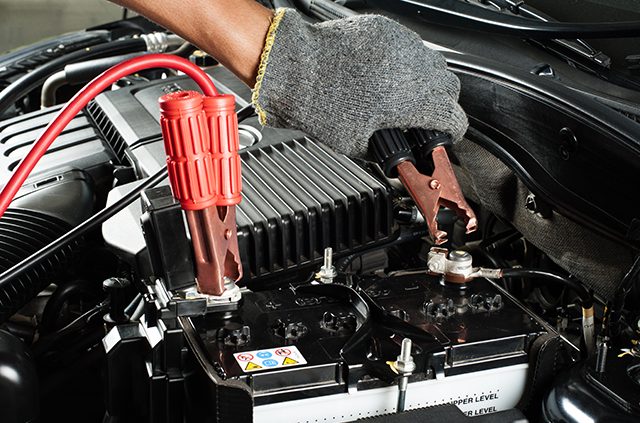
- Connect the positive jumper cable (usually red) to the positive terminal on the “dead” battery. (Typically, the positive battery terminal is marked with a plus sign, while the negative is marked with a minus.) Now that the cable is attached to the battery, states that you should not touch the metal clamps to any metal other than as described below. Doing so could cause an electric shock.
- Connect the other end of the positive cable to the positive battery terminal on the vehicle providing the jump.
- Connect the negative cable (usually black) to the negative terminal on the vehicle providing the jump.
- Connect the other end of the negative cable to an exposed metal part of the vehicle with the dead battery. (Unpainted components like brackets, bolts, etc., often provide the best grounding, which may help prevent sparking.)
- Check that the cables are not near any moving engine parts.
- Start the “booster” vehicle, and let the engine idle for a few minutes. If the battery is a few years old or has been dead for a few weeks, you may consider revving the engine slightly on the booster car to speed up the charging process.
- Start the disabled vehicle.
- If the car with the dead battery starts, let it run for at least 20 minutes. If it doesn’t start, you may need to check the cable connections. If that doesn’t work, you may need a mechanic’s help.
- Keeping the jumper cable away from any metal, begin removing them in reverse order (to help prevent sparking). First, remove the black (negative) cable from the ground on the previously disabled vehicle (keep the vehicle running).
- Remove the other end of the negative cable from the battery of the vehicle providing the jump.
- Remove the positive cable from the battery of the vehicle providing the jump.
- Remove the positive cable from the previously disabled vehicle.
If you are not comfortable performing any of these steps, call a professional for assistance.
THINGS TO KNOW ABOUT JUMP STARTING A CAR
KEEP JUMPER CABLES IN YOUR VEHICLE AT ALL TIMES
Along with road reflectors, a flashlight and some extra wiper fluid, it’s a good idea to have jumper cables stashed in your vehicle’s emergency kit just in case. If your battery goes bad and you need a jump start to get back home, you’ve already got half of the tools you’ll need to do the job. All you need is a donor vehicle with a healthy battery to lend your car a jump start.
Don’t want to fuss with another car just to jump yours, or maybe you’re too shy to ask a stranger to lend a hand? You might invest in a portable jump starter. Portable jump starters feature built-in cables and hold a charge that can jump-start your car in seconds the next time you get stuck.
REMEMBER “RED ON DEAD” WHEN ATTACHING JUMPER CABLES
When hooking up jumper cables between two vehicles, it’s important to do things in the correct order. Remember, you’re working with live electricity. A short-circuit could cause a spark that can even detonate the fumes released by the battery, causing a dangerous explosion! Before attempting a jump start, be sure you know which order to hook the cables up in and take care to ensure both cars are off before you begin.
A handy mnemonic device can help you remember how to begin when hooking up jumper cables: “Red on Dead” means to connect the red (positive) battery cable up to the dead vehicle’s battery first. This will help eliminate the risk of shock, spark, and explosion.
DON’T HOOK UP BOTH CABLES DIRECTLY TO THE DEAD BATTERY
Even if you’ve jump-started your car this way before, conventional wisdom suggests its not a good idea. Connecting both the positive and negative battery cables to the positive and negative terminals on the dead battery can increase the risk of an explosion. Also, it’s not necessary, either.
Instead, the negative battery terminal should be grounded onto an unpainted piece of bare metal under the hood. This completes the circuit without the increased risk of an explosion. Can’t find a good spot to attach the battery cable? Consult your owner’s manual. Many modern cars now provide a special, stamped and marked piece of metal under the hood to which you can simply attach the negative battery cable — that is if you can find it. If you still can’t find a good place to attach both battery cables, give us a call and speak with one of our technicians.